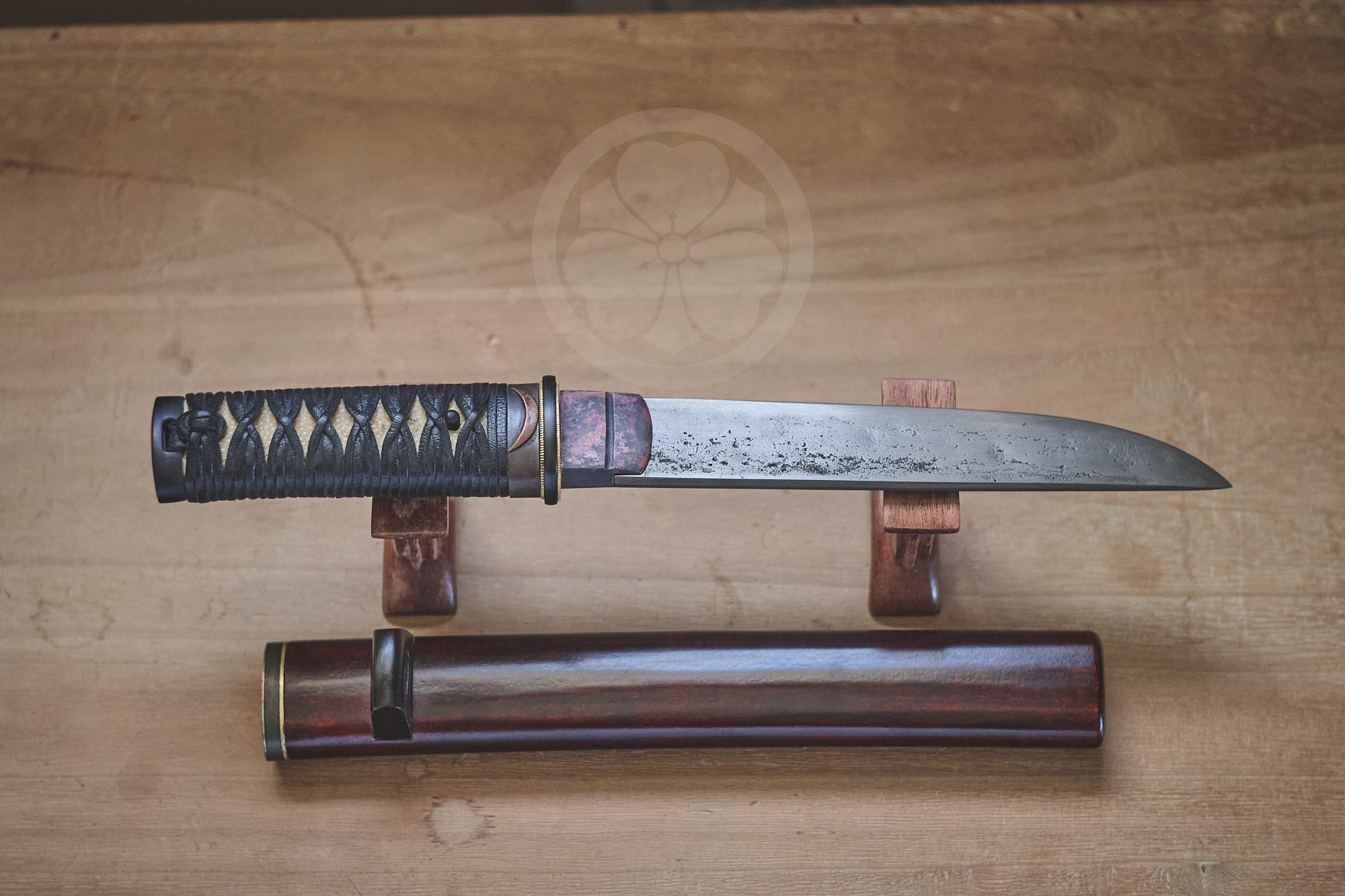
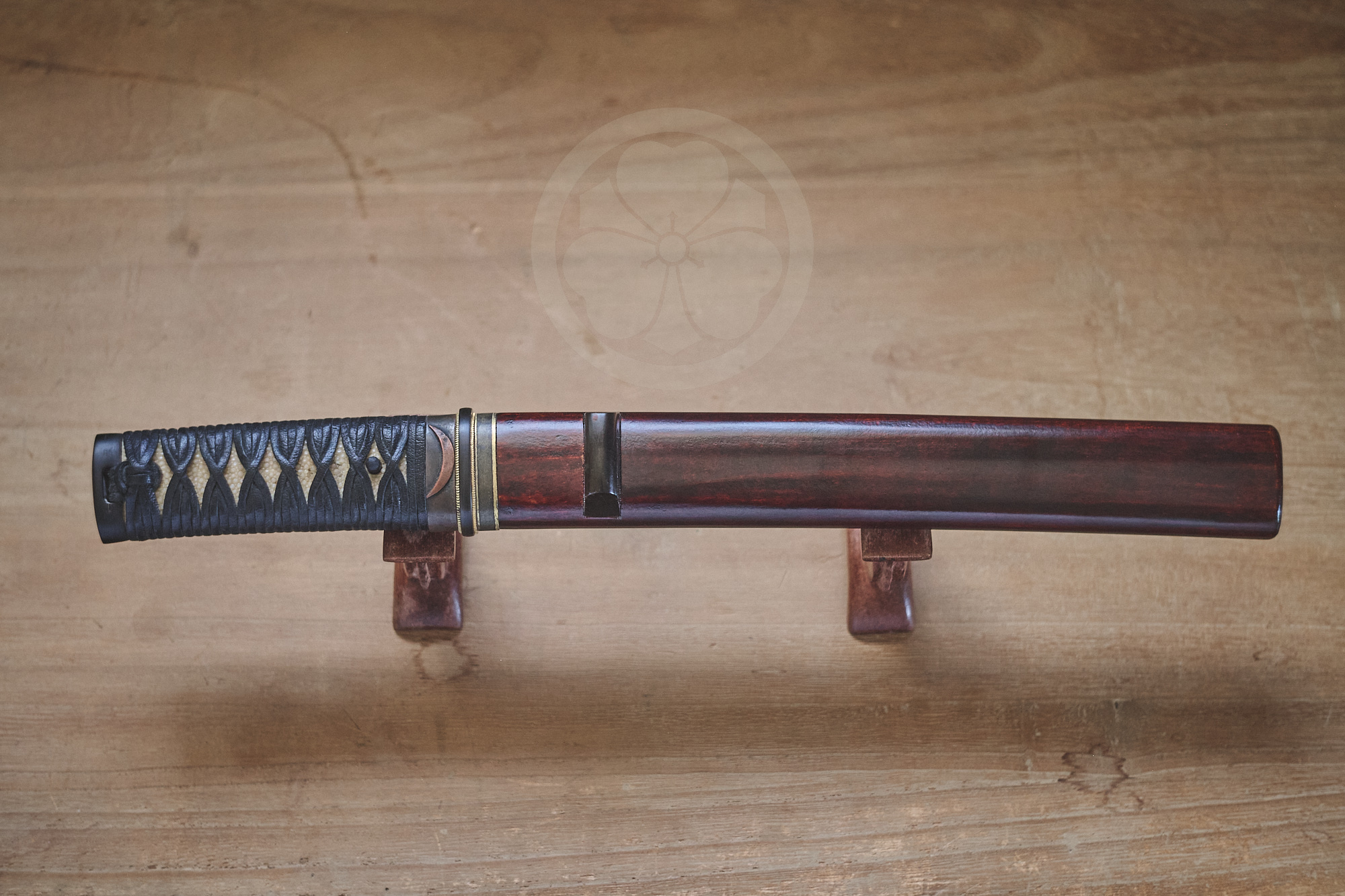
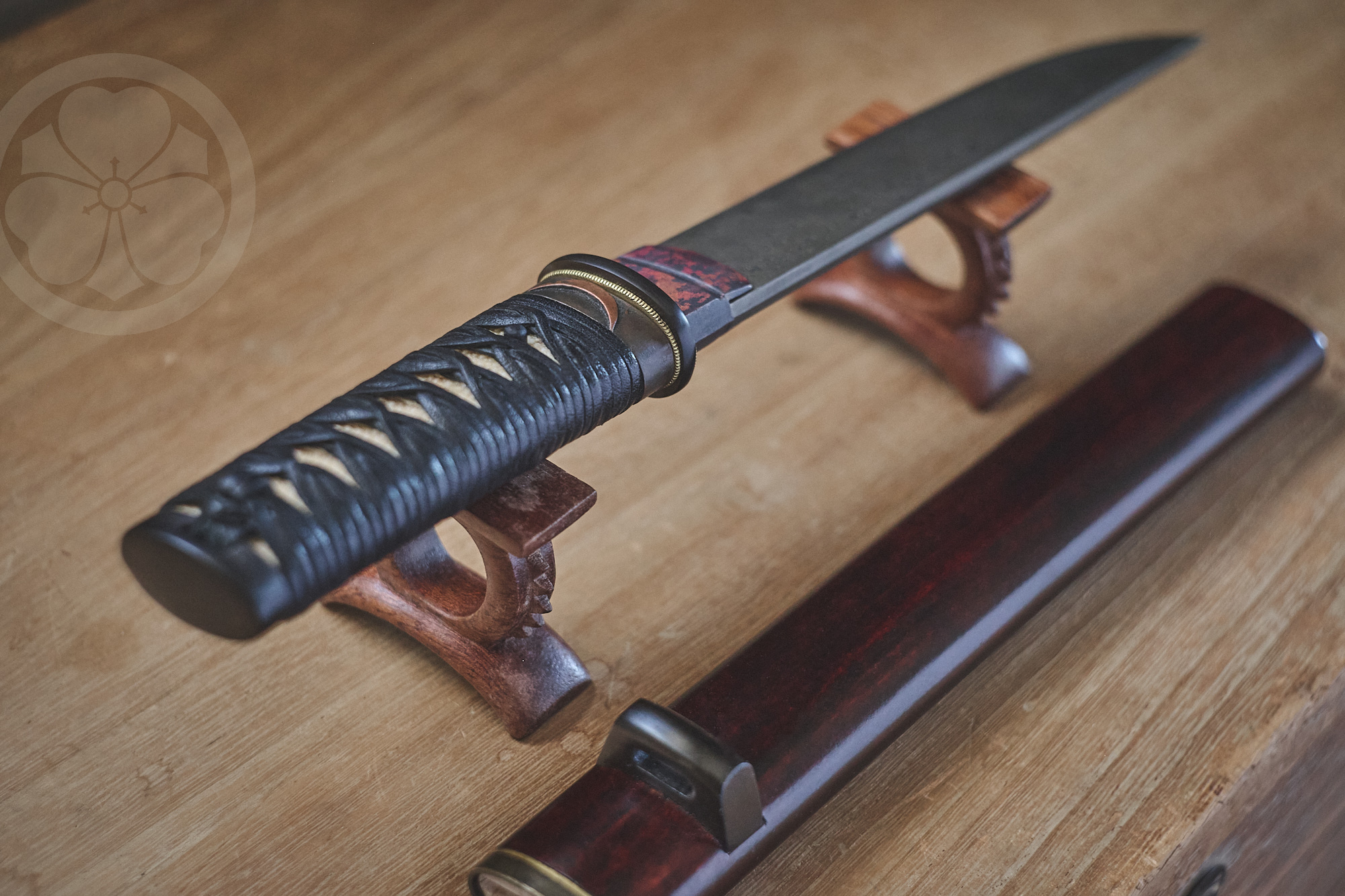
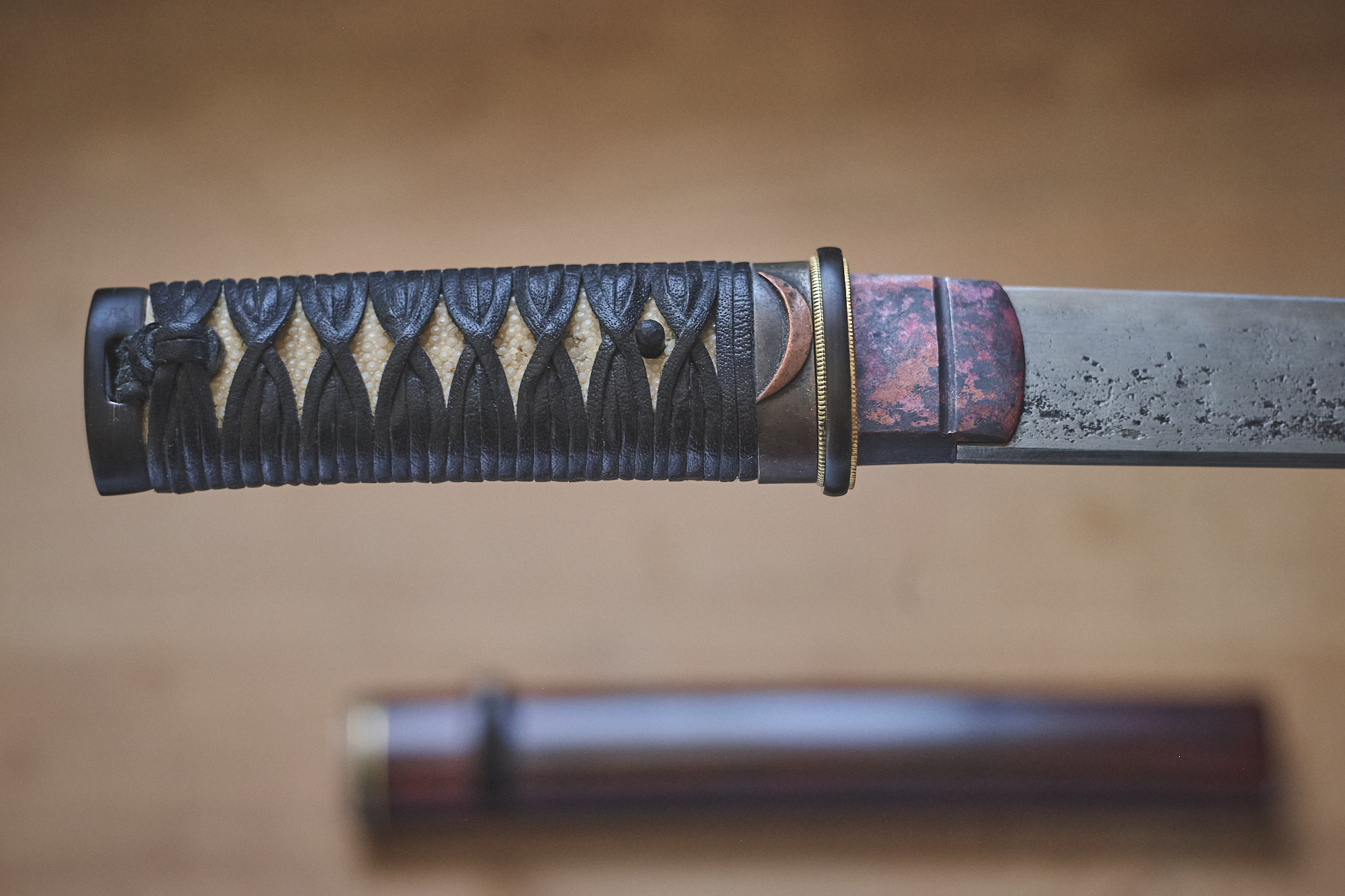
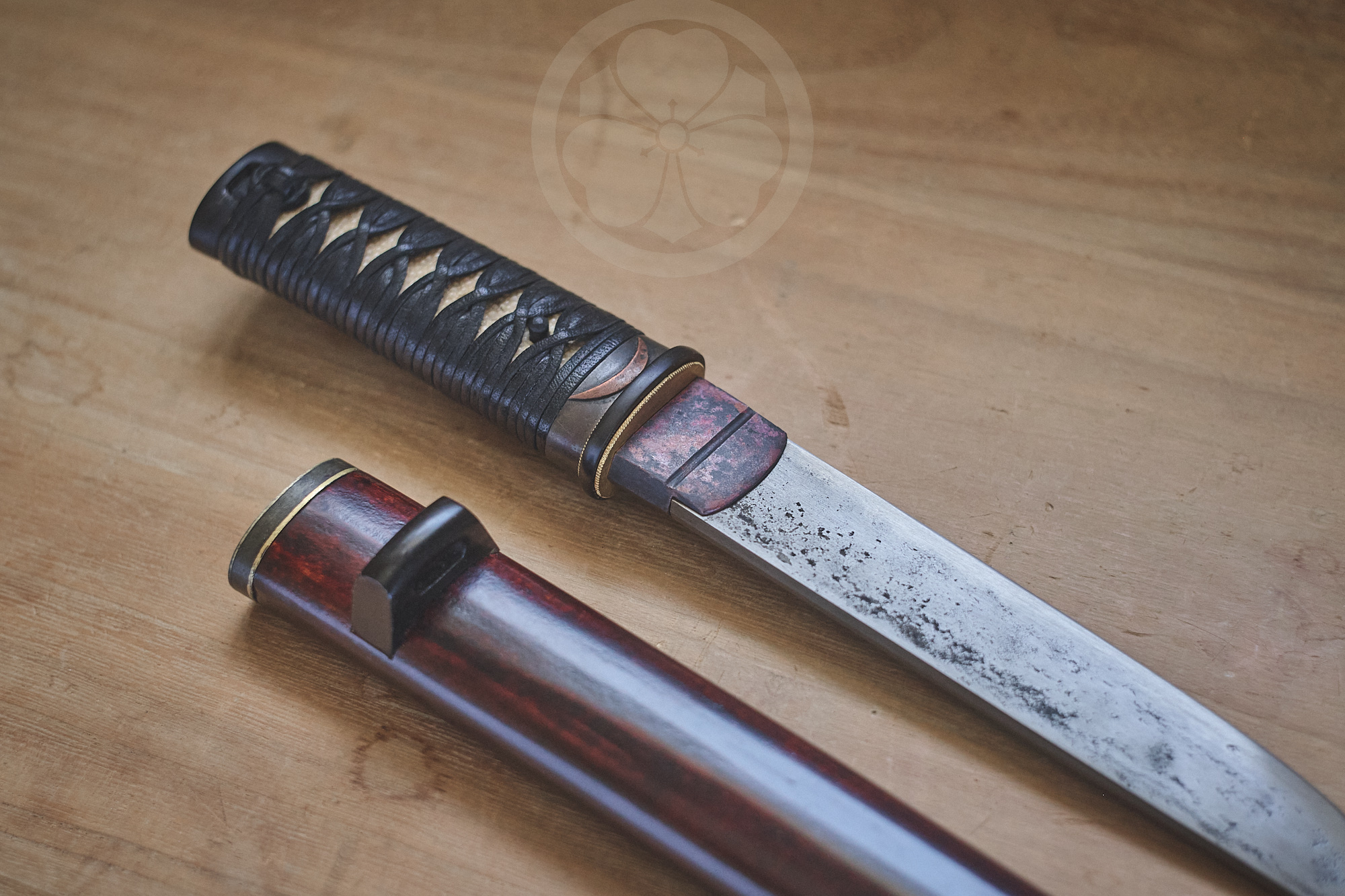
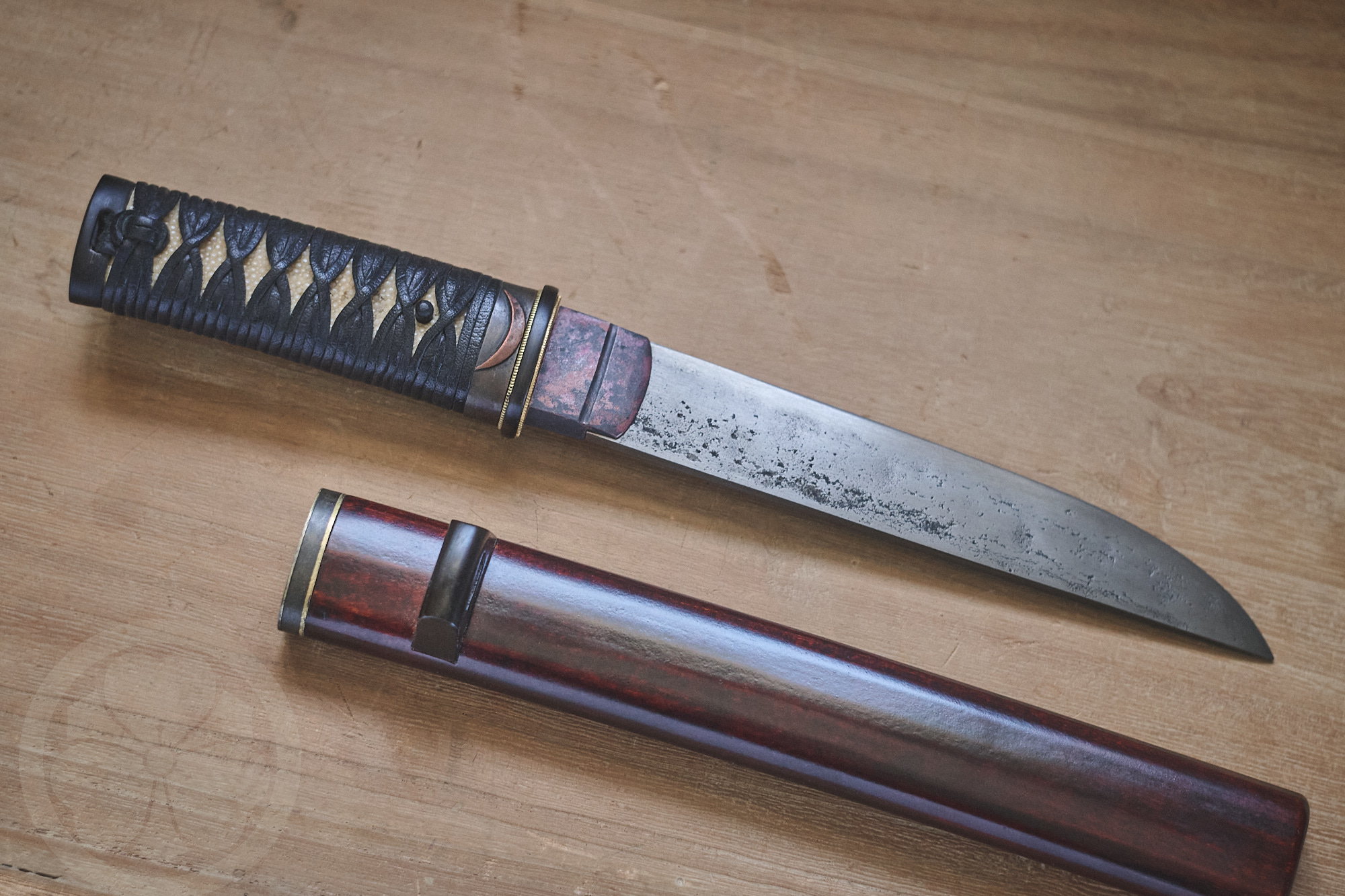
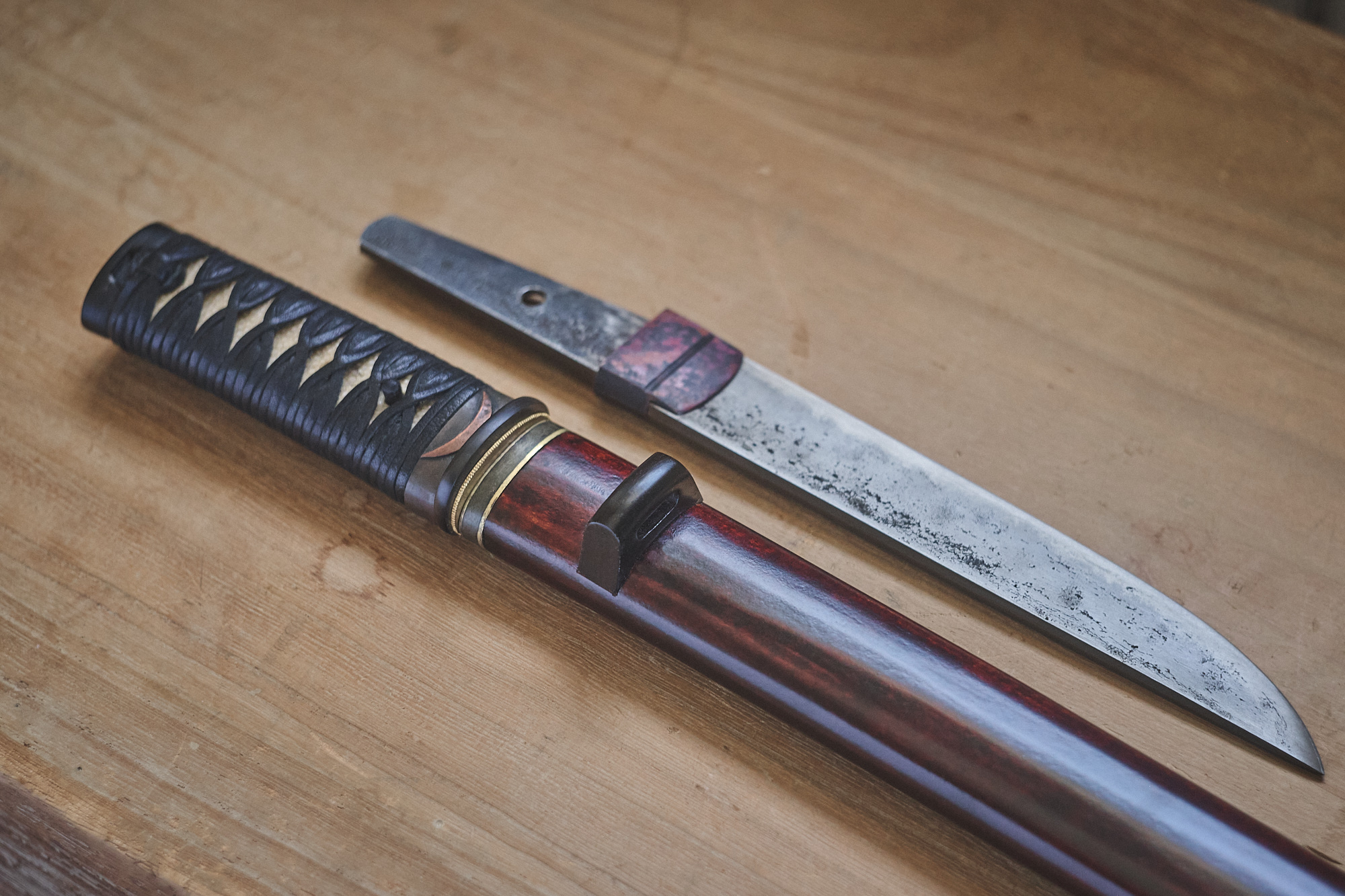
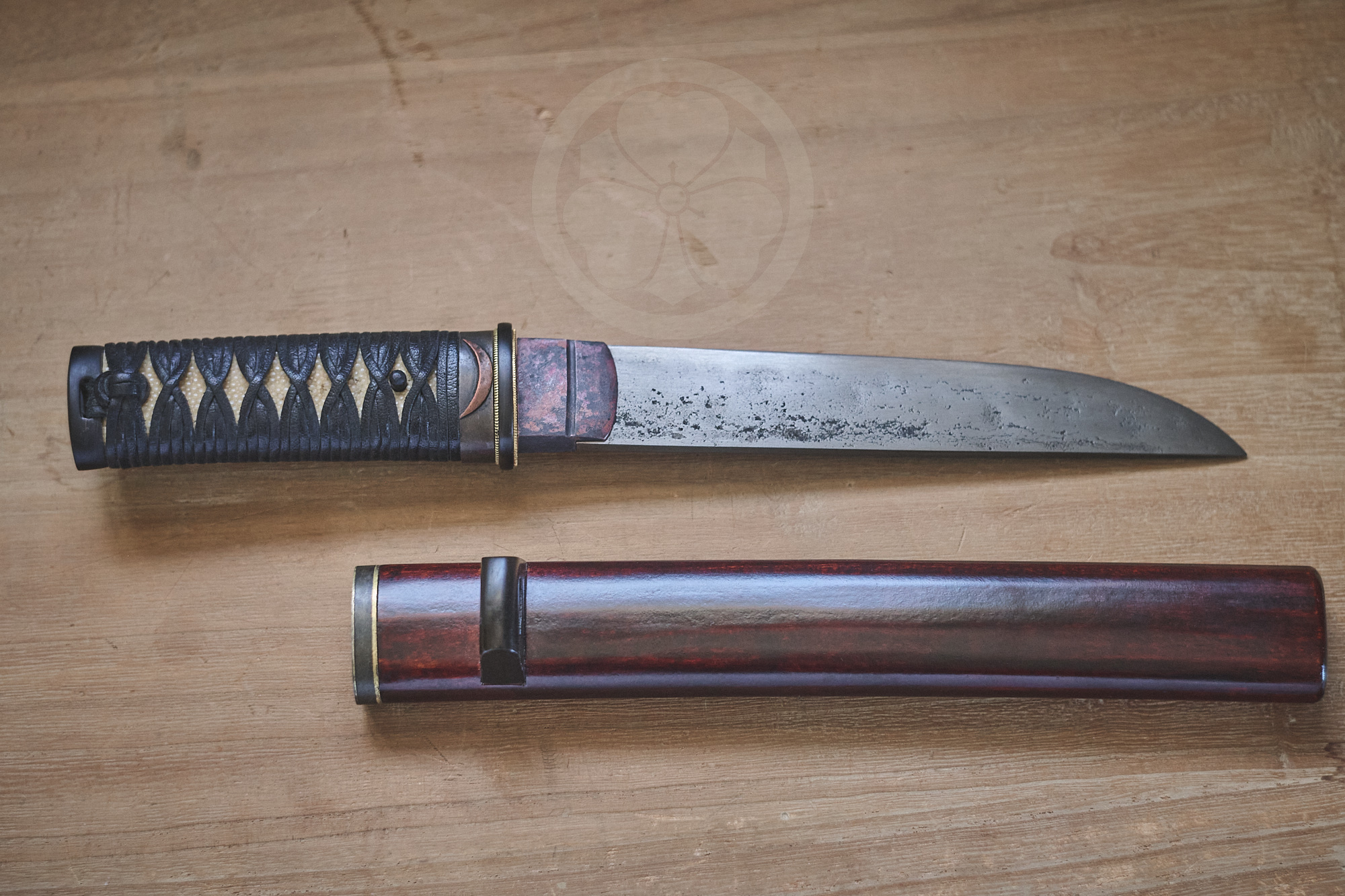
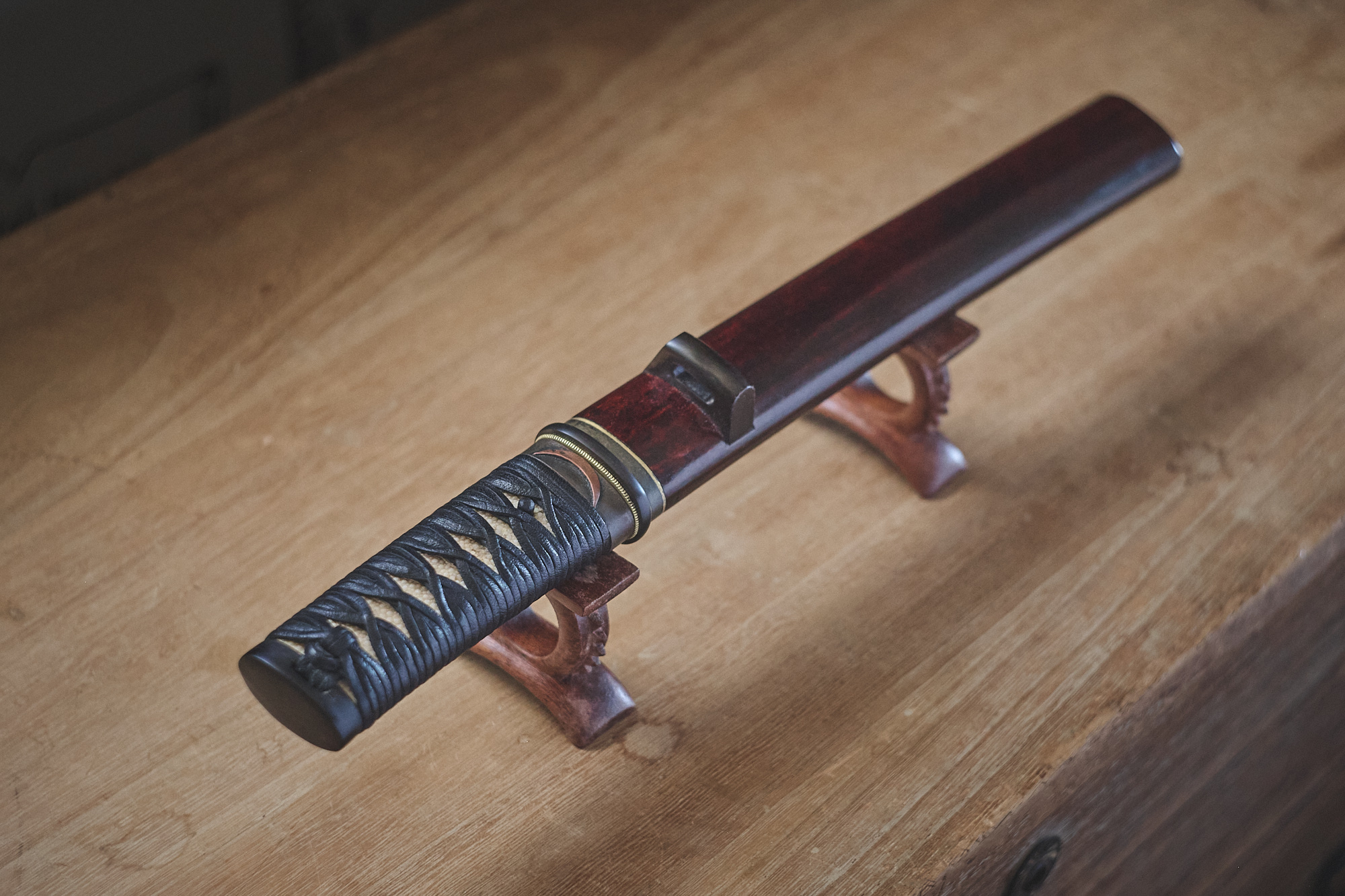
Tsukimizu (月水, “tsu-key-me-zoo”) literally translates “moon-water” and carries the idea of moonlight reflecting in the ripples of a pond or stream. The name is drawn from the layered steel ripples along the edge of the hamon and the motifs of the mountings.
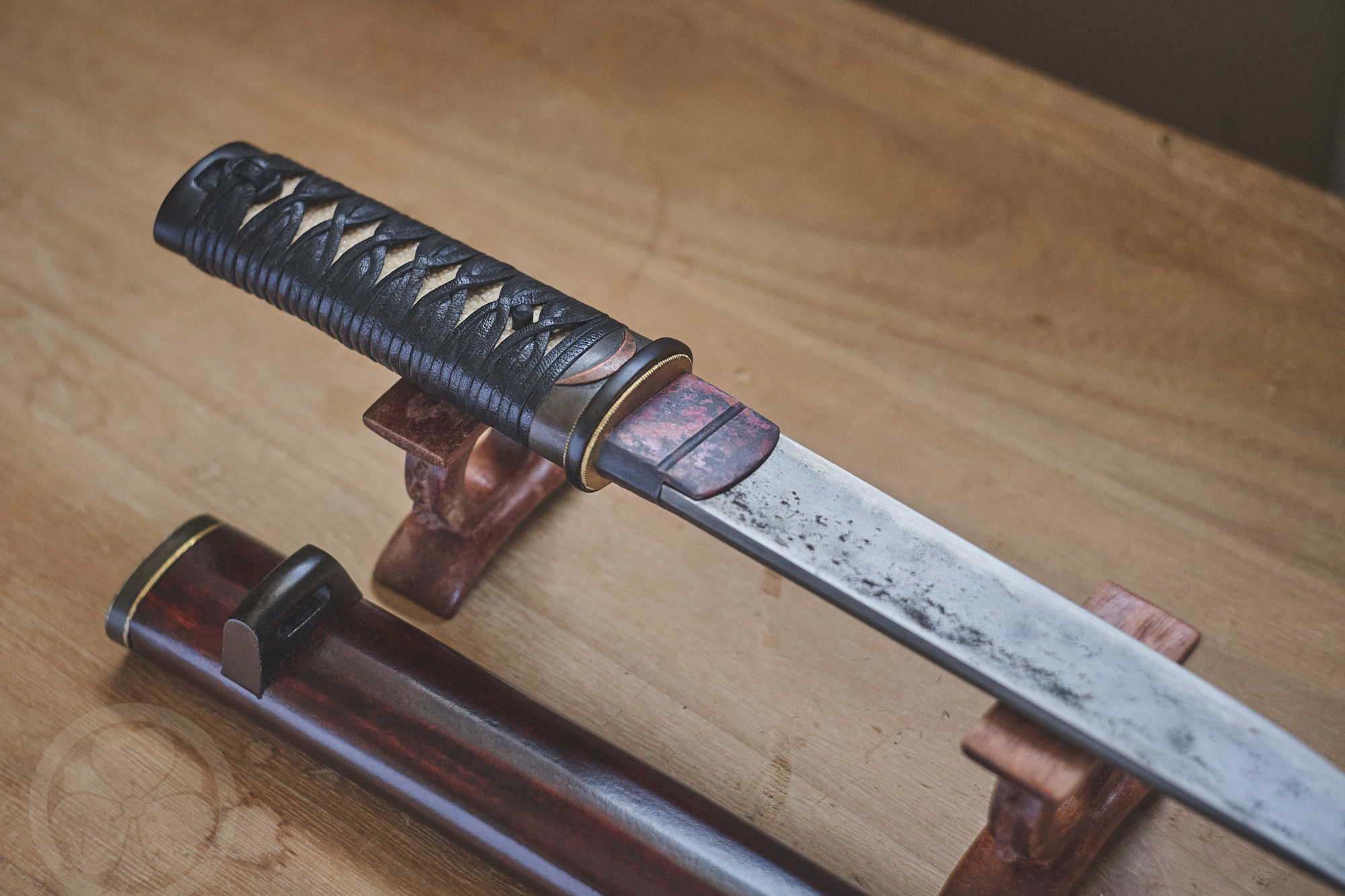
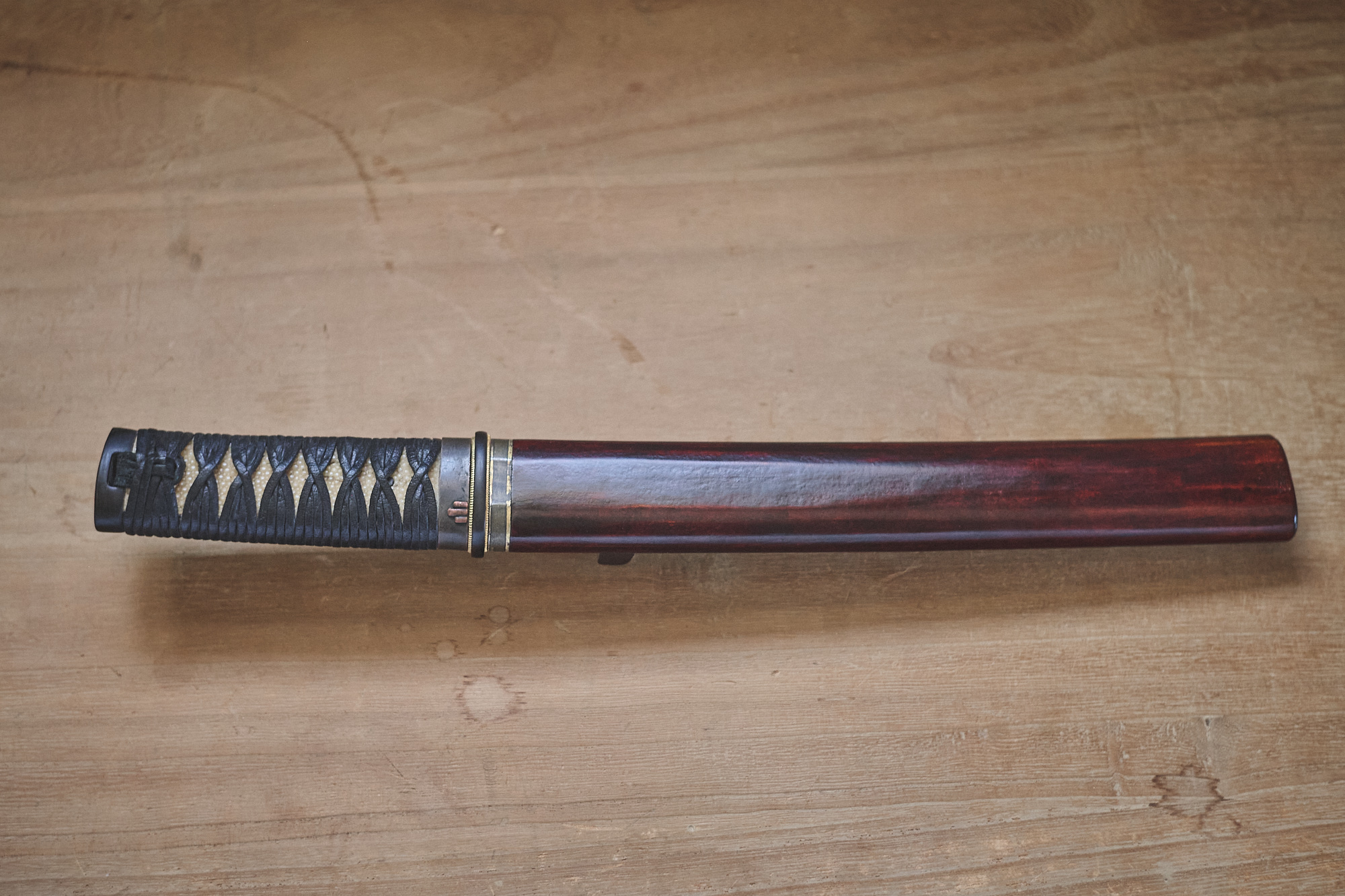
The subtle hammer marks on the charcoal-forged satoyama-style blade, the hand carved and lacquered wooden scabbard, and the antique fittings from swords carried centuries ago—treasures from the kura storehouse—form a traditionally-crafted tool for adventure in classical tanto koshirae.
Forged from century-old pre-industrial shear steel from a mining car rail, the blade retains some of the original pitting along with forged hammer texture. It was partially polished before clay and water yaki-ire (quenching) to reveal the layering in the steel, then sharpened with waterstones from Japan.
Satoyama are the managed forest areas that border the cultivated fields and the mountain wilds in Japan. Historically they provided soil nutrients, firewood, edible plants, mushrooms, fish, and game, and supported many local industries and crafts such as farming, timber construction, and charcoal making. The interaction of forest, arable land, wetlands, and streams are an important component of the satoyama landscape.
The wider blade profile of the mountain style tanto is based on proportions of a classical katana and this blade has a very slight drop point. The temper of this high carbon steel blade has been left relatively hard in order to hold a keen edge. This particular combination of old steel and heat treatment is well suited to users who require a good edge and are willing to take care of it.
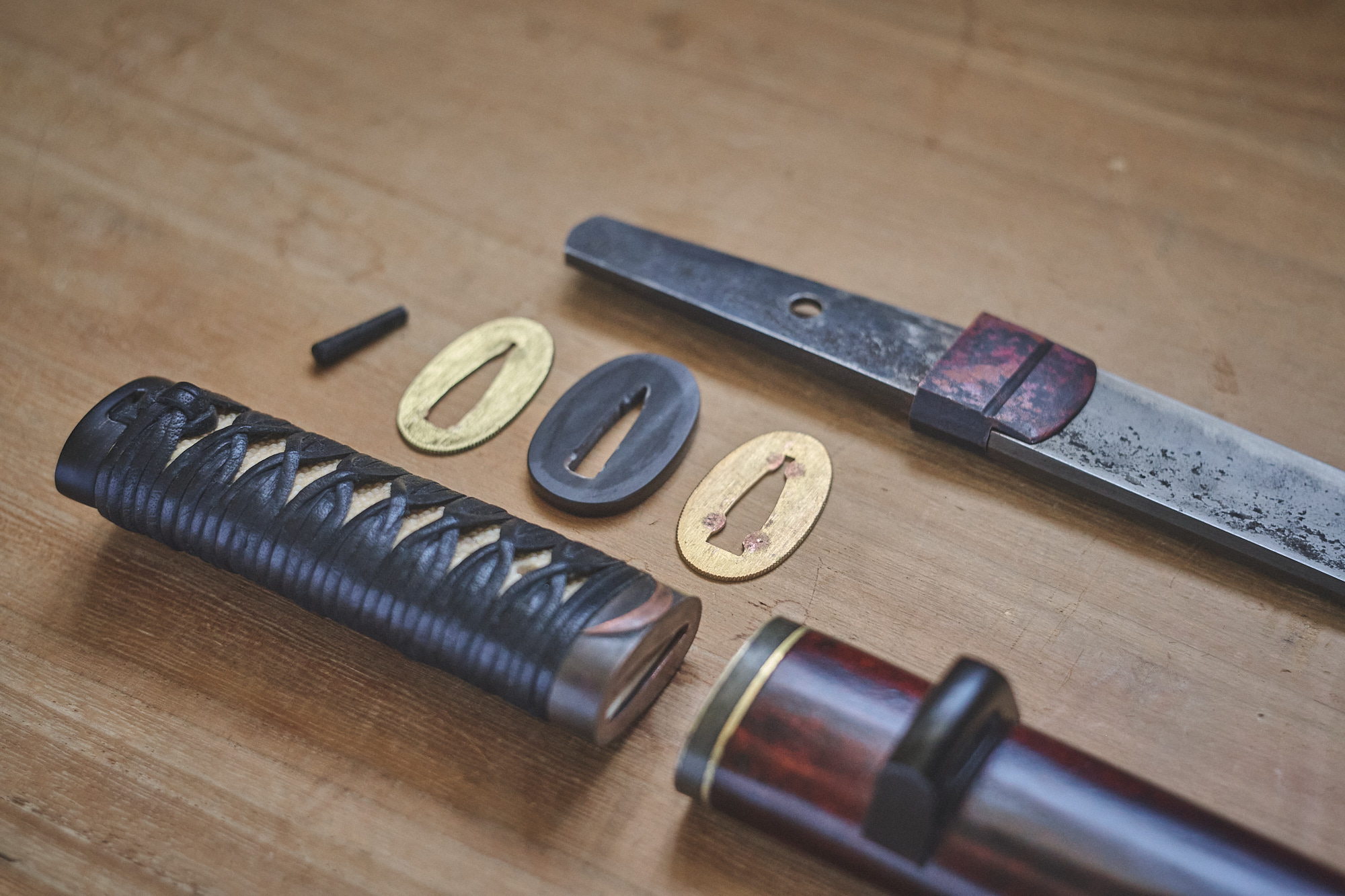
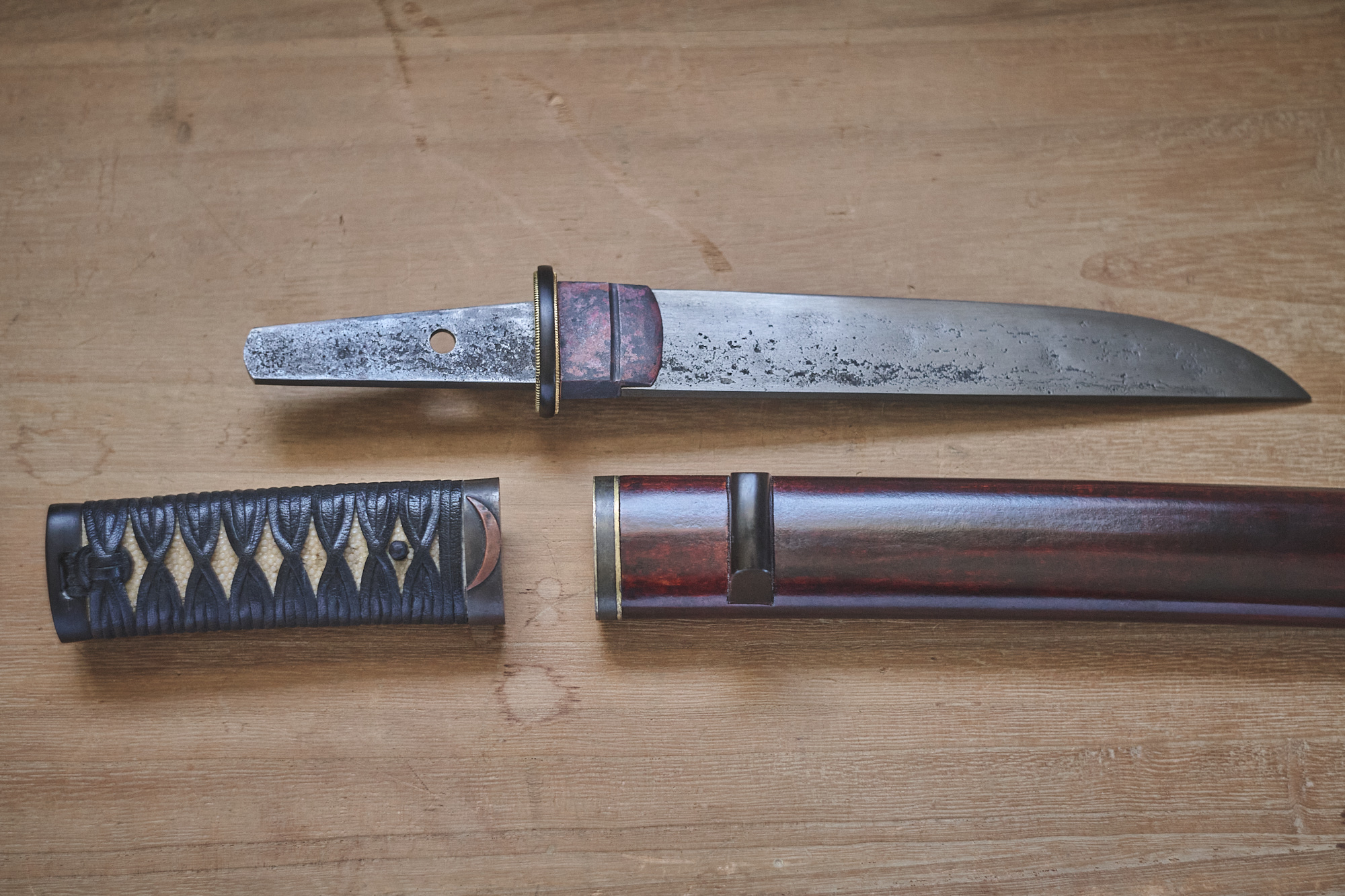
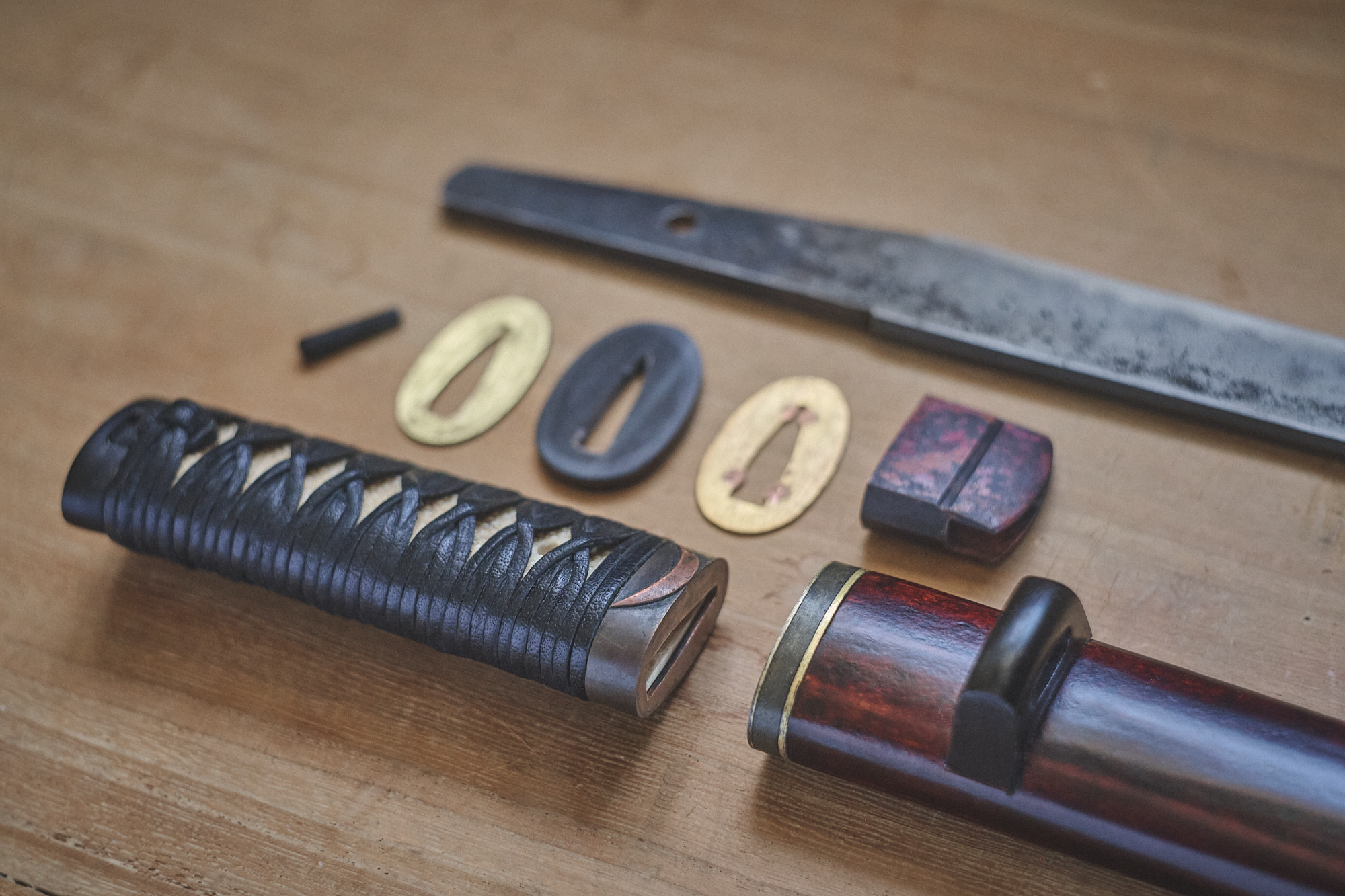
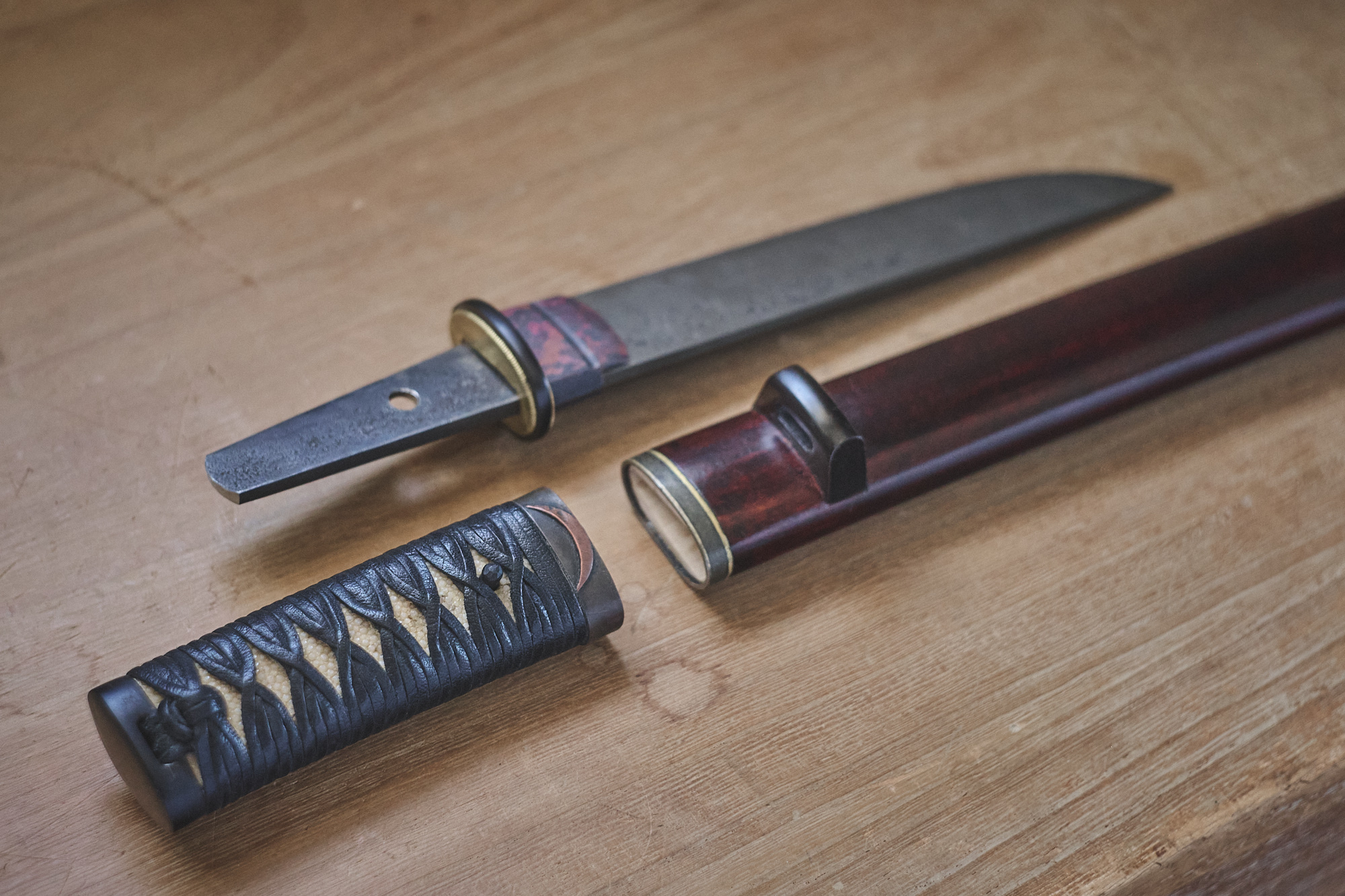
The tang is constructed in a similar manner to a Japanese sword requiring only a single bamboo peg to hold the knife assembly together. In addition to the sense of beautiful simplicity, this design allows the knife to be taken apart for cleaning, polishing, detailed cutting tasks, or major resharpening work.
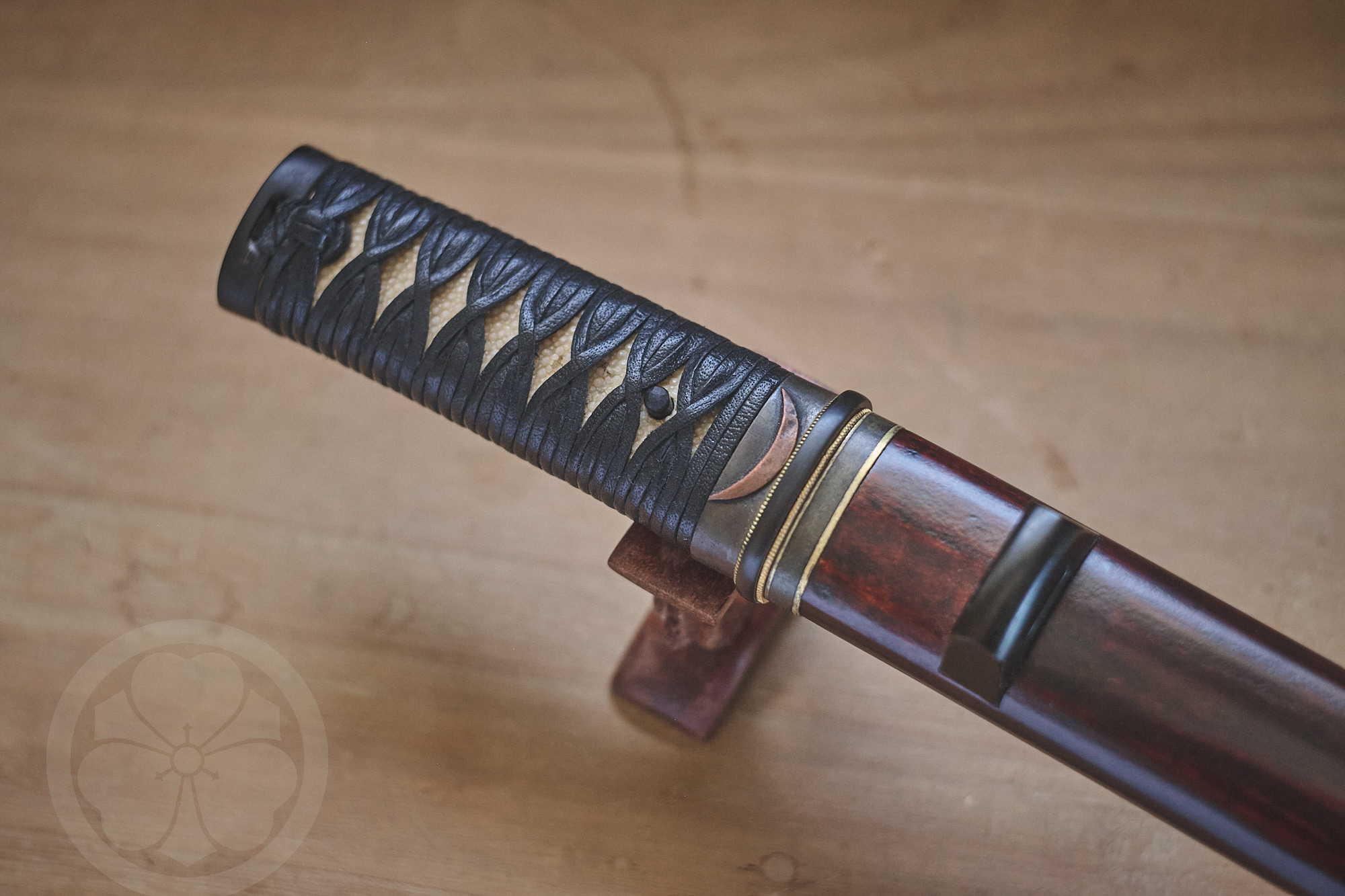
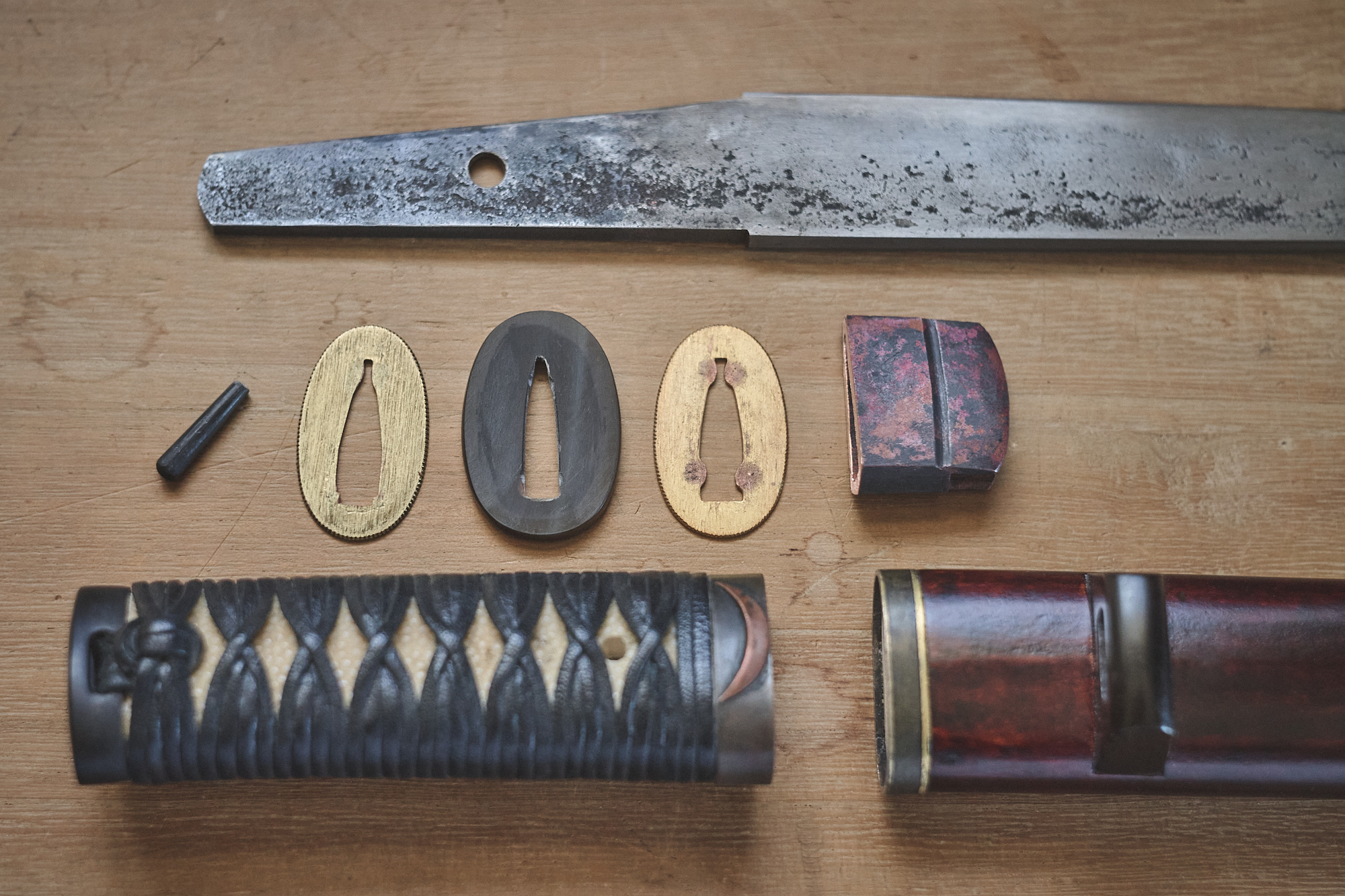
Five reclaimed antique Edo-period sword fittings are incorporated into the mountings: the copper habaki (blade collar), the shakudo fuchi (ferrule of copper and gold alloy) with inlaid copper crescent moon and clouds, two gold-overlaid copper seppa (blade washers), and gold-overlaid shakudo koiguchi (scabbard mouth). Even the samegawa (ray skin) handle under-wrap was carefully repurposed from an antique sword handle.
The handle is carved from Magnolia and finished with traditional leather tsukamaki over samegawa in the style of tomaki nihon kumiage. The mekugi (removable peg), kashira (pommel), and vintage kurikata (cord loop) are water buffalo horn. The scabbard is carved from Magnolia with subtle planed facets and lacquered in a deep crimson colour using multiple layers of unfiltered natural tree-source urushi.
The blade is just under 7.5″ long, overall length about 12.5″, and 15″ when sheathed. The spine at the munemachi is 6.5mm thick. Approximate build time 70-100 hours.
形 Katachi (geometry): hira-zukuri, iori-mune, with slight ubuha
刃文 Hamon (edge pattern): suguha with ko-notare
帽子/鋩子 Boshi (tip pattern): ko-maru
中心/茎 Nakago (tang): futsu, kuri-jiri, one mekugi-ana
銘 Mei (signature): mumei (unsigned)
拵 Koshirae (mounting): satoyama kura style hamidashi, issaku (sole authorship) plus 5 antique parts
Materials: antique mining car rail steel, Magnolia, water buffalo horn, antique samegawa, leather cord, antique fittings, natural-source urushi lacquer
Process
This blade was forged and yaki-ire was performed at the museum forge. It began as a century-old mining car rail that was heavily pitted by rust. The handle and scabbard were crafted at the museum during the summer demonstrations.
This blade was forged from the web of a century-old mining car rail that was deeply pitted by rust.
The steel is very rare and unique in that it is pre-industrial, a form of blister or shear steel that retains layering from the process of refining it under a steam hammer.
This blade was forged from a scrap of the web between the base and the top of the mining car rail.
View of the traditional charcoal forge during the forging of this blade.
The sunobe (blade pre-form) allocates the correct amount of steel to each area of the blade and establishes the tapers, note that the edge is facing upwards.
The bevels forged in, only hammer work up to this point to preserve the entire original volume of steel as much as possible before filing to clean up the profile.
After a bit more adjustment and cleanup before filing in the final details.
After filing the notches and profile and cleaning some of the surface scale by drawfiling, the steel is normalized by thermal cycling to relieve stresses.
Applying the clay for yaki-ire, it will delay the cooling effect and produce a hardened edge with a tough spine.
After yaki-ire some of the layers in the steel are visible along the edge of the hardened hamon area.
An antique katana habaki which has some battle damage will be re-soldered and fit to this blade.
After forging the split shut, silver and borax are placed along the joint. At this point the habaki is slightly undersized for the tang.
Carefully heating the habaki in an “oven” made of charcoal to maintain a reducing atmosphere.
Once the silver liquifies and flows into the joint the habaki is quickly removed from the forge and allowed to cool slowly.
The habaki is cold forged to harden it while it stretches enough to fit over the tang snugly.
The Magnolia is marked and handsawn in half to form the cores of the tsuka (handle) and saya (scabbard) and flattened inside with a kanna (handplane).
After choosing the best grain direction, the tsuka (handle) blocks are carved inside to fit the tang precisely.
The tsuka is glued back together with sokui (rice paste glue), wrapped with leather, and wedged for tension overnight to dry.
Preparing the inside surfaces of the scabbard with a kanna (handplane).
The saya (scabbard) blocks are carved inside to fit the blade precisely.
The saya is glued back together with sokui (rice paste glue), wrapped with leather, and wedged for tension overnight to dry.
The tsuka block is shaped with kiridashi (carving knives) and kanna (hand planes) based on the size and shape of the fuchi (ferrule).
The form is set by carving and then adjusted with a small rasp or file.
Half of the samegawa (ray skin) from an Edo period katana handle will be repurposed, here wet formed and wrapped to dry to the shape of the tsuka.
The profile of the saya is planed into the scabbard block.
Using the antique koiguchi fitting for reference, the shape is roughed in using kanna, refined with kiridashi, and finished with small files. Note the shaving in the scabbard mouth to prevent small chips from getting wedged inside while working.
A small shoulder is carved for the antique koiguchi band to reinforce the scabbard mouth.
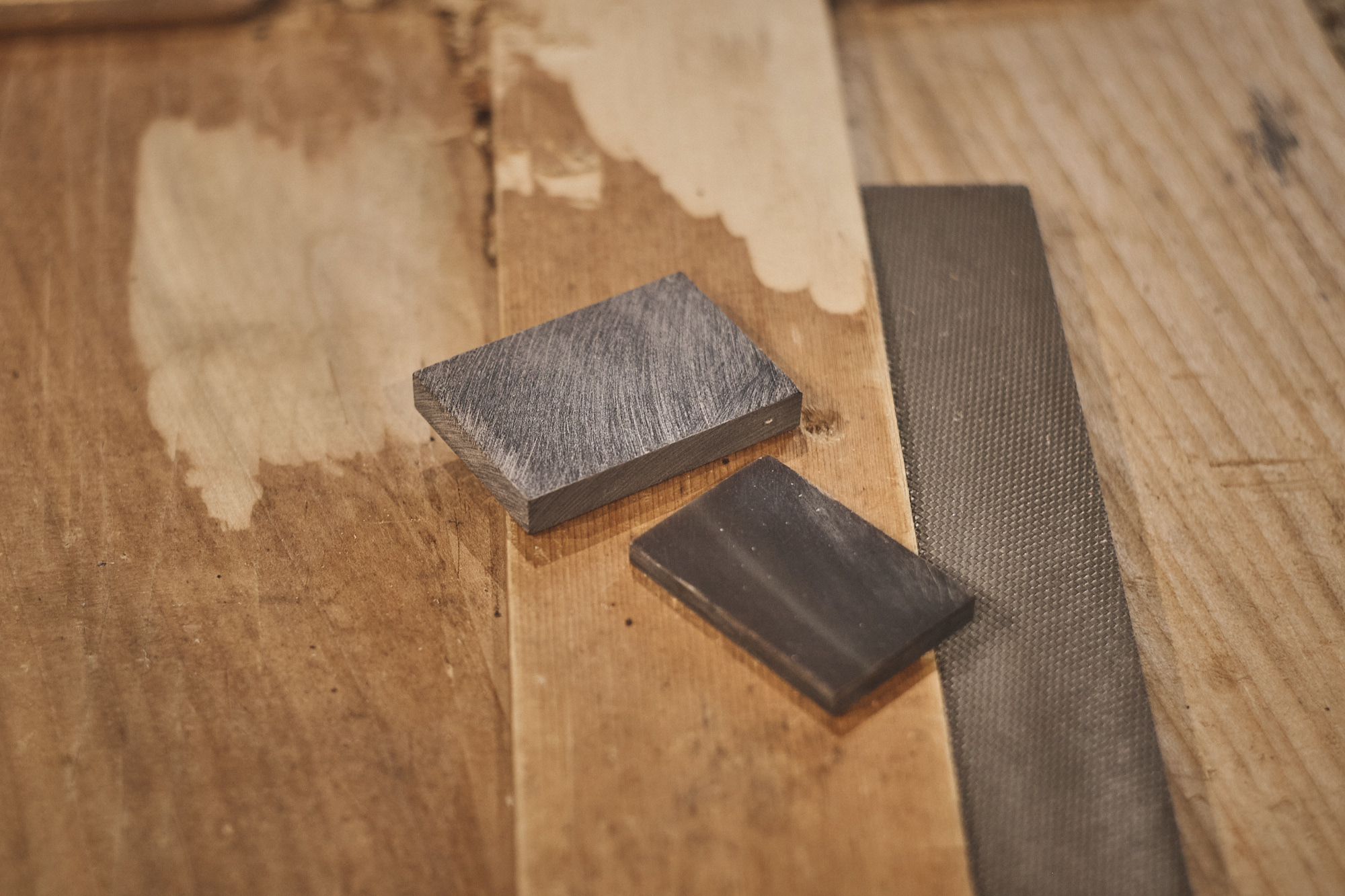
A slice of buffalo horn is flattened to a specific thickness using a coarse file and a diamond stone.
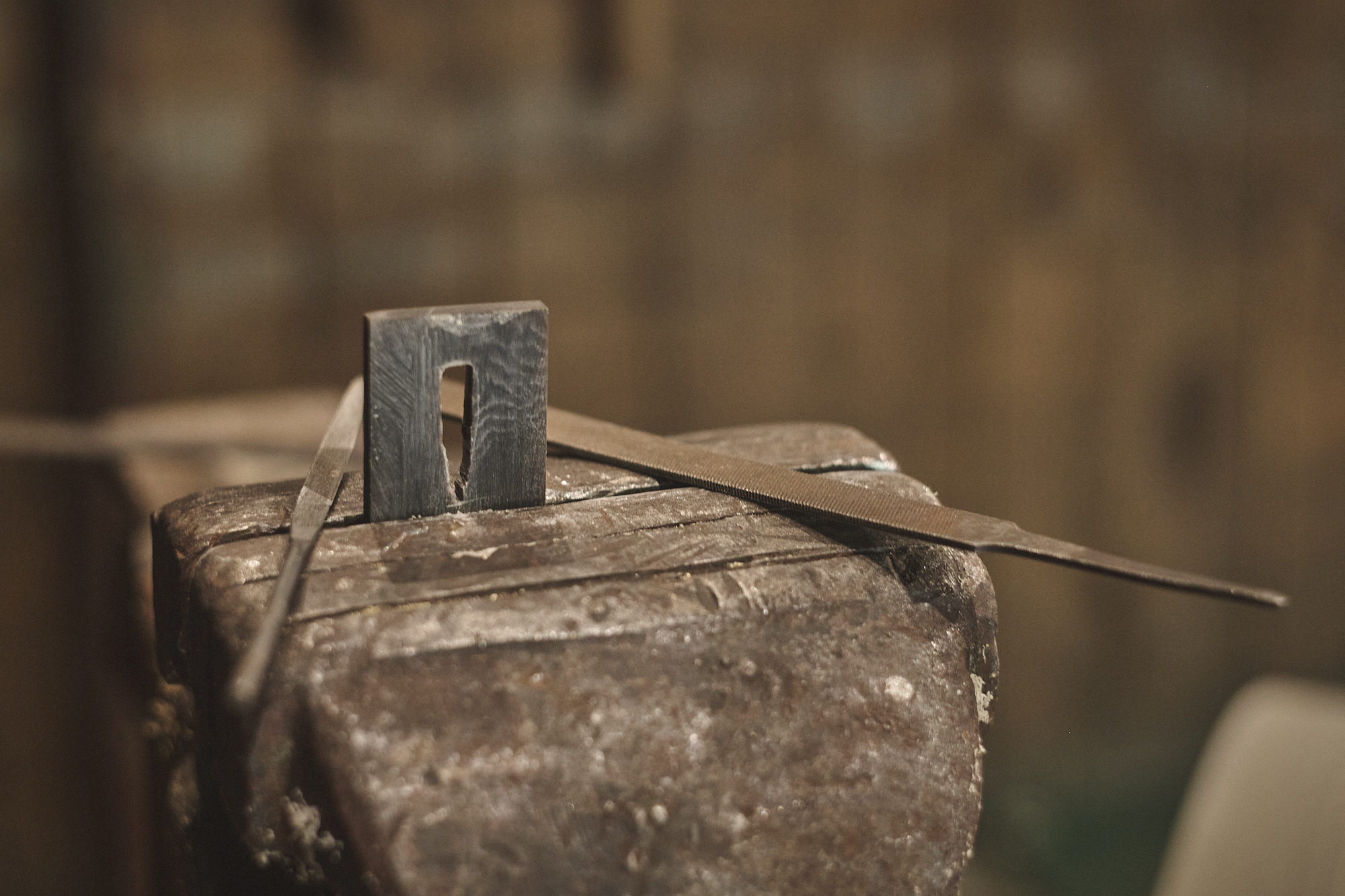
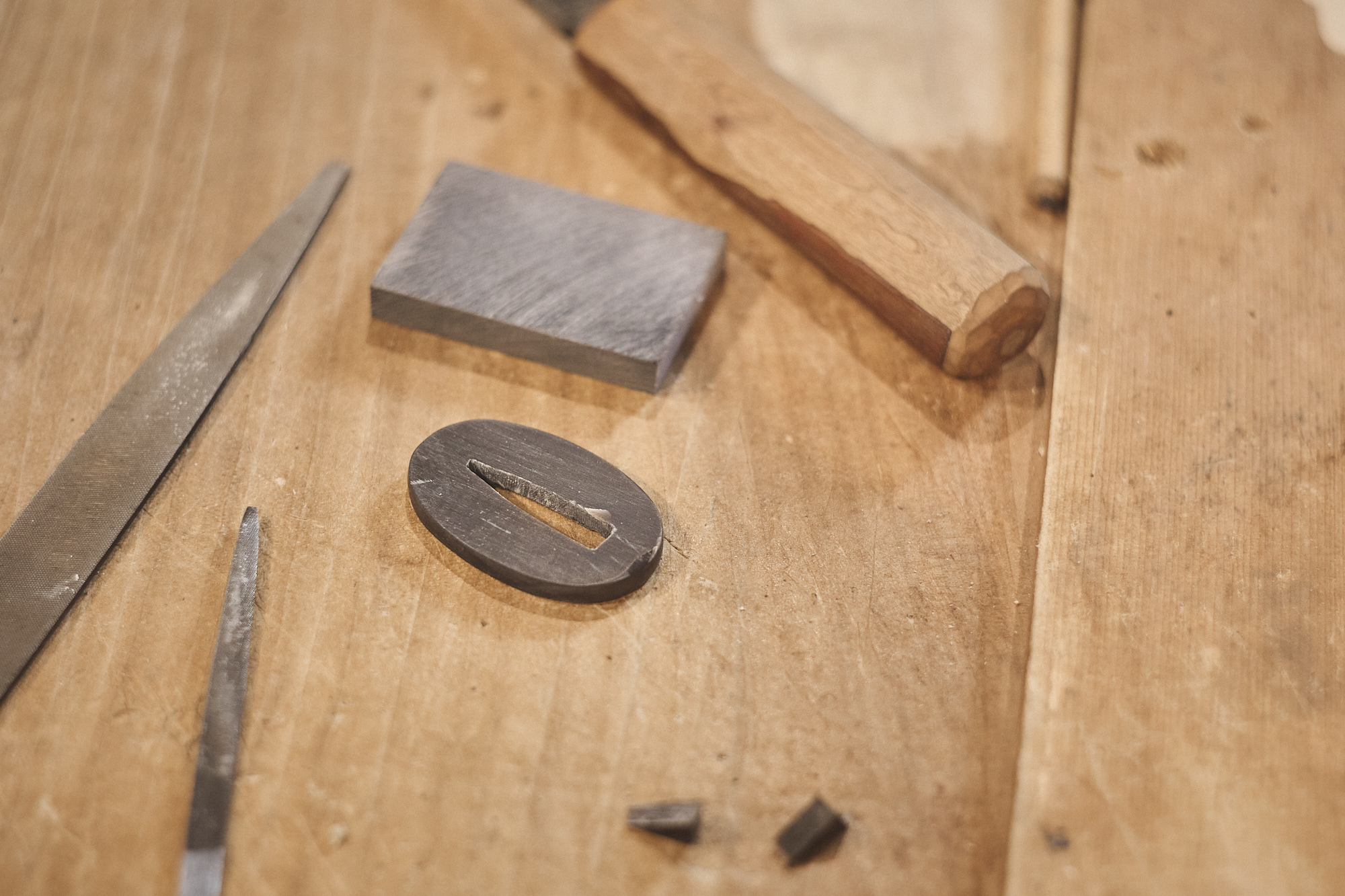
An opening is hand drilled and then carefully filed to match the tang.
The hamidashi style tsuba (handguard) is shaped to match the fittings, polished, and then finished with a fukiurushi technique using natural-source urushi lacquer.
A hole is drilled in the nakago (tang) and the tsuka (handle) then the mekugi is carved from water buffalo horn and adjusted to fit.
Preparing for tsukamaki (handle wrapping), even the hishigami (paper diamonds) under the wrapping will be repurposed from an Edo period sword! The kashira (pommel) is also made from water buffalo horn.
The samegawa has been patched in one place previously, indicating that this is not the first time it has been repurposed from one sword to another. It is attached to the tsuka with sokui (rice paste glue).
In the right light it can be seen that the suguha hamon has taken on some undulating patterns due to variations in the layers of steel.
All parts of the koshirae carefully fit and finished, prepared for final assembly. The kashira, koiguchi, and kurikata have been attached using nikawa (膠, にかわ, natural hide glue).
Direct light reveals some of the deep texture and colour variations in the scabbard, created by layering and selectively polishing thin layers of black and natural urushi over the wood grain.