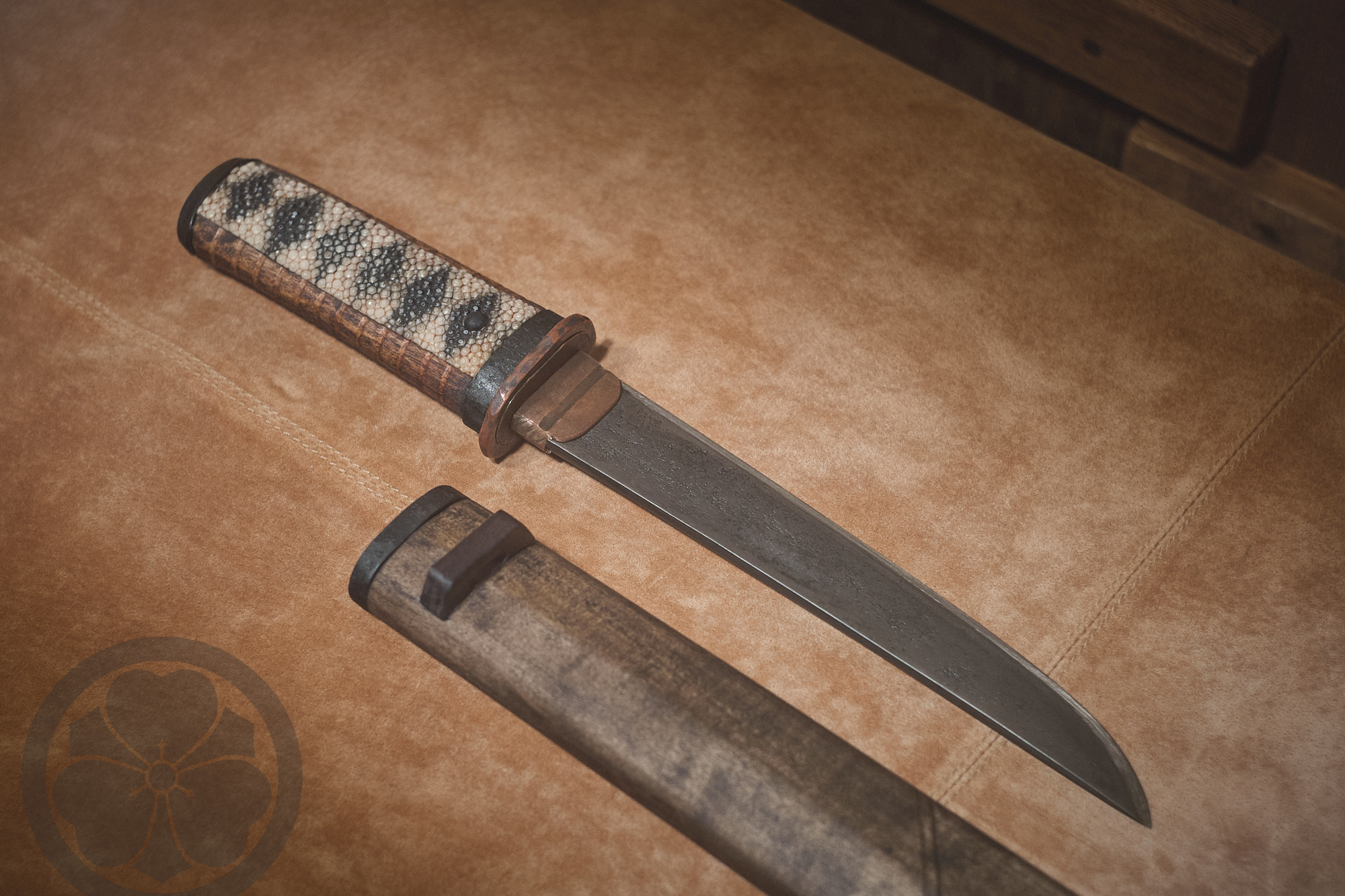
A rover tanto with a charcoal-forged 1965 Series 2a Land Rover leaf spring carbon steel blade, water quenched with clay and sharpened with waterstones, a rustic knife that has the foundation of the Japanese sword, a nihonto inspired mounting accented with parts reclaimed from antique swords.
The subtle and rustic appearance of hammer marks on the blade and hand-carved wooden handle finished with 100% natural urushi made from tree sap—reminiscent of hand-hewn beams in a kominka farm house that are darkened by years of smoke drifting up from the irori hearth.
Forged from a reclaimed 1965 Series 2a Land Rover leaf spring, the blade profile of the mountain style kotanto is based on a kamakura sword and has deeper profile. The temper of this high carbon steel blade has been left relatively hard in order to hold a keen edge for tasks such as wood carving and hand work. This particular combination of steel and heat treatment is well suited to users who require a good edge and are willing to take care of it.
The tang is constructed in a similar manner to a Japanese sword requiring only a single buffalo horn peg to hold the knife assembly together. In addition to the sense of beautiful simplicity, this design allows the knife to be taken apart for cleaning, polishing, detailed cutting tasks, or major resharpening work.
The handle and scabbard are carved from Magnolia and finished in traditional fukiurushi lacquer made from tree sap. Antique sword parts include a habaki, seppa, and unique samegawa (rayskin) panels from an Edo period katana. The removable peg is carved from buffalo horn and blends in with the black sumi (calligraphy ink) painted diamonds on the samegawa. The denchu-kojiri style scabbard has a steel koiguchi and the kurikata is carved from blackwood.
The blade is just over 7″ long, the overall length is 12″, and about 13.5″ when sheathed. The spine at the munemachi is about 5mm thick.
This knife was forged and underwent yaki-ire at the museum forge. It began as a section of leaf spring from a 1965 Series 2a Land Rover, which seems to be listed as 60sicr8 steel and has not changed formulation since 1948 when the very first series 1 Rover was built.
Ready for a day at the museum forge, the old 1966 Rover still earning its keep hauling tools overland at almost 60 years running (and on its original springs).
A load of several hundred pounds of tools ready for a day at the forge.
Opening the forge and preparing to unload the tools and steel.
This knife began as a section of leaf spring from a 1965 Series 2a Land Rover, nearing the end of its useful service life on a vehicle that was undergoing restoration.
A cold chisel was used to separate the leaves of the spring, then the leaves are cleaned of the deepest pitting, cut and sorted by size and condition.
The charcoal swordsmith style forge with hand-powered wooden box bellows is used to heat the steel as it is forged.
View across the forge and out to the forest between heats on a cool and cloudy spring morning.
After a few hours the steel has been forged almost entirely to its final shape using a hand hammer.
A small amount of hand filing forms the notches and cleans up the spine and tang, completing the profile.
A simple sen-dai (staple vise) holds the blade flat while the bevels are cleaned slightly with a file and stones.
After some final cold straightening the steel is ready for hardening with a traditional swordsmithing technique. A mixture of natural clay, charcoal powder, and polishing stone powder is prepared with water.
Adding the thin clay layer to delay the cooling of the body of the blade during yaki-ire (hardening).
After the clay dries, the steel is heated carefully in the forge to the lowest possible red-hot critical temperature and plunged into water to cool quickly.
It has survived the stressful process of yaki-ire. Due to the differential cooling rates the strip along the edge is now very hard while the rest of the blade remains tough and ductile, the best of both realms.
After some cleaning up the blade is ready to move to the next stage.
A small piece of copper is cold chiseled off from a reclaimed industrial electrical bus bar.
A tsuba (guard) is forged from the copper and an opening is punched for the tang and adjusted by filing and hammering.
A fuchi (ferrule) and koiguchi (scabbard mouth) are sawn and then forged from a section of reclaimed steel pipe.
The proportions of the fuchi and koiguchi are based on antique katana fittings.
Finally, a kashira (pommel) is punched from reclaimed steel plate and shaped using special punches, a hammer, and files.
The simple iron fittings will be left with the dark oxide finish from the forge.
Paired with an antique Edo period habaki (blade collar) it now has all its fittings and waits with other rover knives to move on to the mounting stage.
A piece of Magnolia sawn in half and planed flat inside will become the handle and scabbard.
First the handle halves are carved to fit the tang then the position for the blade is marked before carving inside the scabbard.
The interior of the scabbard is carved for the blade and then adjusted to fit the habaki snugly.
After gluing with sokui (rice paste glue) and tightly clamping the joint overnight it is allowed to cure for several days before further work.
The scabbard and handle are carved down to align with the fittings step by step using kanna (hand planes), chisels, and kiridashi knives.
As the final shape approaches the pommel is fit into place and the handle is sculpted subtly in the style of a classical tanto.
A blackwood kurikata (cord loop) is carved and fit into place on the scabbard with a sliding dovetail.
Nikawa (hide glue) will hold the kurikata permanently in place once the final lacquering stages are complete.
These interesting samegawa (ray skin) panels came from an Edo period katana. The black diamonds appear to have been painted with traditional sumi, calligraphy ink made with soot and nikawa (hide glue).
After carefully choosing the placement of the diamonds, the panels are cut to approximate length and the handle is carved to inlay them.
The samegawa is moistened with water and then tightly wrapped into place to harden following the form of the wood. After lacquering they will be glued into place with sokui (rice glue) or nikawa (hide glue).
The placement for the mekugi-ana is chosen and drilled through the tang using an antique hand-cranked post drill.
The mekugi (retaining peg) is carved from a scrap of reclaimed buffalo horn, keeping the grain aligned for strength.
The mekugi is carefully fit before cutting to length.
Carefully measured grooves are filed into the exposed areas of the handle as a final detail before lacquering.
After multiple layers of natural fukiurushi have cured the blade is finally sharpened and the knife is ready for assembly.