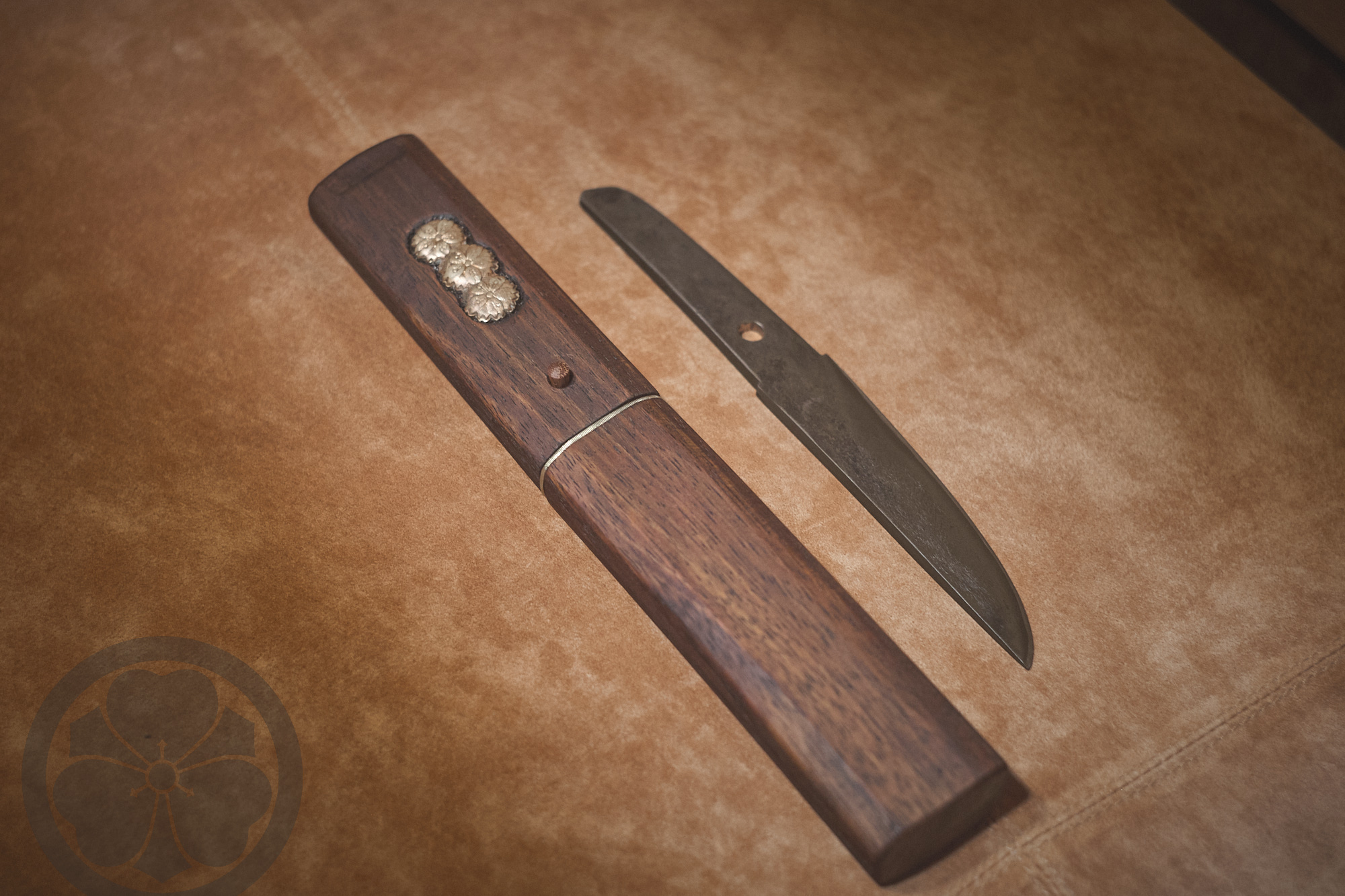
A rover kotanto with a charcoal-forged 1965 Series 2a Land Rover leaf spring steel blade, water quenched with clay and sharpened with waterstones, a small knife that has the foundation of the Japanese sword, a simple wooden mounting accented with a vintage sword part.
The subtle and rustic appearance of hammer marks on the blade and hand-carved wooden handle finished with 100% natural urushi made from tree sap—reminiscent of hand-hewn beams in a kominka farm house that are darkened by years of smoke drifting up from the irori hearth.
Forged from a reclaimed 1965 Series 2a Land Rover leaf spring, the narrower blade profile of the stream style kotanto is based on a yoroidoshi tanto and has an elegant taper with slight drop point. The temper of this high carbon steel blade has been left relatively hard in order to hold a keen edge for tasks such as wood carving and hand work. This particular combination of steel and heat treatment is well suited to users who require a good edge and are willing to take care of it.
The tang is constructed in a similar manner to a Japanese sword requiring only a single bamboo peg to hold the knife assembly together. In addition to the sense of beautiful simplicity, this design allows the knife to be taken apart for cleaning, polishing, detailed cutting tasks, or major resharpening work.
The handle and scabbard are carved from hardwood and finished in traditional fukiurushi lacquer to a beautiful deep colour. Antique gunto sword sakura menuki from the 1940s and a forged brass seppa accent the handle and the removable peg is carved from susudake, a piece of bamboo that served for a century or more as part of the ceiling or roof in a kominka, darkened and hardened by decades of smoke wafting up from the irori hearth.
The blade is just under 4″ long, the overall length is just under 8″, and about 9″ when sheathed. The spine at the munemachi is about 4mm thick.
This knife was forged and underwent yaki-ire at the museum forge. It began as a section of leaf spring from a 1965 Series 2a Land Rover, which seems to be listed as 60sicr8 steel and has not changed formulation since 1948 when the very first series 1 Rover was built.
Ready for a day at the museum forge, the old 1966 Rover still earning its keep hauling tools overland at almost 60 years running (and on its original springs).
A load of several hundred pounds of tools ready for a day at the forge.
Opening the forge and preparing to unload the tools and steel.
This knife began as a section of leaf spring from a 1965 Series 2a Land Rover, nearing the end of its useful service life on a vehicle that was undergoing restoration.
A cold chisel was used to separate the leaves of the spring.
The leaves are cleaned of the deepest pitting, cut and sorted by size and condition before forging to shape on the anvil.
The charcoal swordsmith style forge with hand-powered wooden box bellows is used to heat the steel as it is forged.
View across the forge and out to the forest between heats on a cool and cloudy spring morning.
The sunobe (preform) is taking shape.
The material for the tang is isolated from the original bar and cut off with a chisel.
After many heats the steel has been forged almost entirely to its final shape using a hand hammer.
A small amount of hand filing forms the notches and cleans up the spine, bevels, and tang, completing the profile.
After some final straightening the steel is ready for hardening with a traditional swordsmithing technique.
A mixture of natural clay, charcoal powder, and polishing stone powder is prepared with water. Adding the thin clay layer delays the cooling of the body of the blade during yaki-ire (hardening).
After the clay dries, the steel is heated carefully in the forge to the lowest possible red-hot critical temperature and plunged into water to cool quickly. If it survives the stressful process of yaki-ire, due to the differential cooling rates the strip along the edge is now very hard while the rest of the blade remains tough and ductile, the best of both realms.
A seppa (blade washer) is roughly cut from an annealed reclaimed brass door push plate using hammer, chisel, and shears.
A scrap of hardwood will become the handle and scabbard. First the handle halves are carved to fit the tang snugly.
The interior carved and ready for fixing together using nikawa (hide glue).
Once the glue has been allowed to cure for a week, the exterior can be shaped using kanna (hand planes), chisels, and kiridashi knives.
Excess wood is first removed with kanna (handplanes) down to the finished block dimensions, based on the seppa.
And then the profile is shaped with mameganna (small hand plane) to meet the shape of the seppa.
Finally the ends of the handle and scabbard are sawn to length and shaped with a chisel and files.
The placement for the mekugi-ana is chosen and drilled through the tang using an antique hand-cranked post drill.
The mekugi (retaining peg) is carved from susudake, bamboo that has spent the greater part of a century as part of the ceiling or roof inside a kominka farmhouse, darkened and strengthened by the smoke from the hearth.
A pair of vintage 1940’s sakura (cherry blossom) menuki from a gunto katana will accent the handle, first outlined with a kiridashi knife.
And then material is carved out to inset into both sides of the handle and provide strong mounting points.
The surface of the wood is smoothed with fine files and the mounting is ready for lacquering.
After multiple layers of natural fukiurushi have cured over several weeks the menuki are glued into place with nikawa (hide glue), the blade is finally sharpened, and the knife is ready for assembly.