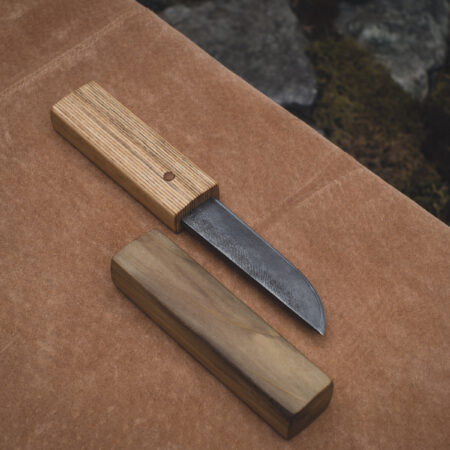
This knife was forged from a piece of very special old steel and has been paired with part of a seventy year old pear tree and an existing leather sheath. The custom leather sheath was part of an estate sale and was hand crafted on Vancouver Island.
The tang is constructed in a similar manner to a Japanese sword requiring only a single bamboo peg to hold the knife assembly together. In addition to the sense of beautiful simplicity, this design allows the knife to be taken apart for cleaning, polishing, detailed cutting tasks, or major resharpening work.
The core of this project is a charcoal-forged blade, water quenched with clay and sharpened with waterstones, a satoyama style knife that has the foundation of the Japanese sword. The extremely rare steel for the blade came from a century-old mining car rail and the fittings are forged from a scrap of electrical washer and reclaimed copper pipe. The handle is carved from a seventy-year-old Pear tree that came from along the Alberni Highway and the removable peg is carved from African bamboo. The handle is finished with several layers of 100% natural tung oil to highlight the delicate grain and colour of the Pear.
The blade is just over 5″ long with a 4″ handle, an overall length of 9.25″, and around 9.75″ when sheathed. The spine at the munemachi is 5mm thick.
形 Katachi (geometry): hira-zukuri, iori-mune, with slight ubuha
刃文 Hamon (edge pattern): suguha
帽子/鋩子 Boshi (tip pattern): ko-maru
中心/茎 Nakago (tang): futsu, ha-agari kuri-jiri, one mekugi-ana
銘 Mei (signature): mumei (unsigned)
拵 Koshirae (mounting): satoyama rustic, issaku (sole authorship) except leather sheath
Materials: reclaimed mining car rail steel, Pear wood, copper electrical bus washer, copper water pipe, Bamboo, vegetable tanned leather sheath
This piece is in a private collection in British Columbia.
Process
This blade was forged, yaki-ire performed, and mounted at the museum forge. The extremely rare steel for this blade came from a century-old mining car rail sourced on Vancouver Island.
Century-old mining car rail sourced on Vancouver Island.
It is likely a century old at minimum and could even be a form of pre-bessemer steel.
Part of the web, though deeply pitted, has the correct starting proportions for a small knife.
The left will be the tip, spine at the bottom and edge at the top, the hole at the right where the tang will end, and the widest and thickest part where the chalk line is will form the machi area between blade and tang.
After forging sunobe (pre-form), hizukuri (bevelling) brings the geometry almost to finished dimensions by hammer work only, leaving the interesting texture of the forest along the spine.
The machi (notches) are filed in and the tang given traditional geometry.
A small hairline crack was discovered near the tip which had to be cut off, reforged, and reshaped. This unfortunate event is what allowed the blade to fit into this particular sheath.
Applying the clay for yaki-ire, it will delay the cooling effect and produce a hardened edge with a tough spine.
A tiny scrap of electrical bus washer still holds enough copper for a small hamidashi style guard.
It is carefully forged into the appropriate dimensions for the sheath and hot-punched with a nakago shaped punch.
A scrap of copper water pipe was forged to the correct size to form the ferrule.
Fitting the tsuba (guard) to the tang with files and frequent checking.
After filing the outside of the tsuba to the finished size the rim is textured with a small hammer.
The finished proportions are calculated to fit snugly into the sheath.
Carving the inside of the hard Pear block to precisely fit the tang.
The halves glued back together with sokui (rice paste glue) and wrapped with leather cord overnight. Wooden wedges increase the tension and clamping force until fully dry.
Using a kanna (hand plane) to take the exterior of the block down to approximate dimensions.
The front end of the handle is almost to finished dimensions before carving the shoulder for the ferrule.
Checking the symmetry while carving the pommel area.
Using a kiridashi (carving knife) to shape the pommel of the handle.
Drilling the mekugi-ana in the tang with a hand cranked post drill.
A tube rivet formed from copper pipe is peened into the chamfered edges of the wood to add strength and a mekugi (retaining peg) is carved from African bamboo.
After the Pear wood is coated with several layers of 100% natural tung oil and allowed to cure, the ferrule is attached with nikawa (hide glue).
The knife is ready for final assembly.
The knife was featured as part of the display for Railway Days at the museum.
The display case containing work forged from rail steel, along with the portfolio book.
**Please note that in order to preserve the patina and texture of the reclaimed components involved in this mounting there may be minor damage, scuffs, variations in colour, and other indications of their stories over the centuries. This is very old steel with a high level of carbon and and should be sharpened with a very light touch.